Skip to product information
1 of 3

Colombia - Luis Aguirre

Colombia - Luis Aguirre

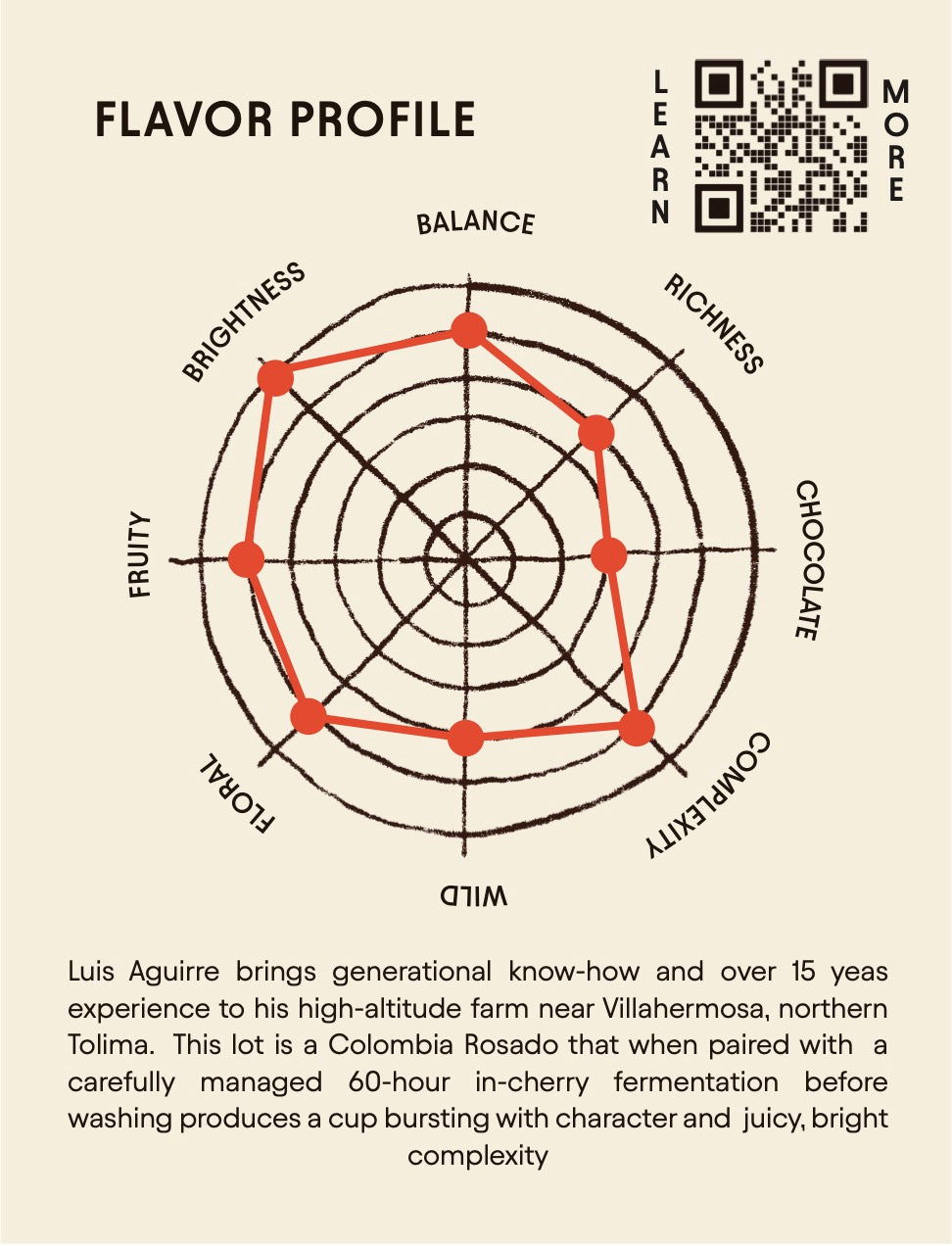
A lush cup layered with mango lassi, cherry preserves, and ripe apricot. Creamy and deeply sweet with vibrant, complex acidity that carries through a long, elegant finish.

Regular price $35.00 CAD
Regular price $0.00 CAD Sale price $35.00 CAD
Sale Sold out
Shipping calculated at checkout.
Size
Grind Size
Quantity

View full details

Technical Info

Producer: Luis Aguirre

Region: Villahermosa, Tolima, Colombia

Harvest: Winter 2026

Varietal(s): Colombia Rosado (pink bourbon)

Process: Double fermentation washed

Altitude: 1900 masl

Exporter: La Real Expedición Botánica

Importer: Bold Bean 

Agrton Gourmet Color: 108 (light)

Roasters Cupping Score: 88.5

Recommended Resting Time: 2-3 weeks

Coffee Story

For much of Colombia's modern coffee history, success has been measured by productivity. Producers were encouraged to plant disease-resistant hybrid varieties capable of producing high yields while delivering the familiar profile people have long associated with Colombian coffee. Those coffees play an important role in Colombia's coffee economy, providing consistency and dependable production at a national scale. But for small producers hoping to be recognized for the quality of their individual farms, that system often leaves little room for distinction.

That's the system Luis Aguirre spent years working within on his farm outside Villahermosa, Tolima. Like many of his neighbors, he grew high-yielding hybrid varieties destined to be blended into larger regional lots, with prices tied largely to the commodity market. While these cultivars produce impressive volumes, they also demand significant chemical inputs and rarely reward the unique qualities of a particular farm. As Luis watched producers in regions like Huila earn higher prices by focusing on exceptional quality instead of maximum production, he decided to take a different path.

Over the past several years, Luis has gradually replaced many of those hybrids with traditional quality-focused varieties, intentionally trading volume for flavor. His farm sits at nearly 1,900 meters on the slopes of Colombia's Cordillera Central, where cool mountain temperatures slow the ripening of the coffee cherries. That extended maturation allows sugars and organic acids to develop more fully, producing dense seeds capable of remarkable sweetness, vibrant acidity, and a cup that speaks clearly to both the variety and the place it was grown.

That transition to specialty accelerated when Luis joined CDNT (Caficultores Diferenciados del Norte del Tolima), a producer collective founded by our friend Herbert Peñaloza Correa through LaREB (La Real Expedición Botánica). Together, CDNT's producers are working to elevate coffee quality throughout the Palocabildo, Casabianca, and Villahermosa region of northern Tolima, an area with extraordinary potential that has historically received far less attention from specialty buyers than many of Colombia's more famous coffee-growing regions. Just as importantly, the collective connects producers directly with buyers willing to pay for quality rather than simply volume, making investments like Luis' worthwhile.

Getting to Luis' farm helps explain why coffees from this corner of Tolima remain relatively uncommon. Start in Casabianca, climb onto a motorbike, and spend about ninety minutes winding into the mountains. When the road finally gives way to mud, park the bike and walk the last mile. Arrive at the farm where you'll find Luis waiting with a cup of coffee and lunch, and before long it becomes obvious why he chose the harder path. Every decision on his farm has been made with one goal in mind: producing coffee that reflects this place as faithfully as possible.

This is the second year LaREB has exported Luis' coffee and the first year we've had the opportunity to roast it. His inaugural export went exclusively to buyers in Europe. After tasting this lot, we immediately knew we wanted it here. It captures everything we love about northern Tolima: remarkable sweetness, vibrant structure, and the unmistakable character that emerges when a producer chooses quality over quantity.

Collapsible content

Varietal

Colombia Rosado is better known throughout the coffee world as Pink Bourbon, a name that came from the variety’s distinctive pinkish-orange fruit and the long-held belief that it was simply a color mutation of Bourbon. Recent genetic research has complicated that story, showing that this variety is not a true Bourbon at all and likely has Ethiopian ancestry. For that reason, we use the more accurate name Colombia Rosado, while still including Pink Bourbon because that is the name many coffee drinkers and producers know.

The variety has become one of Colombia’s most celebrated contributions to modern specialty coffee. When grown well, especially at high elevations, Colombia Rosado can produce coffees with remarkable clarity, layered sweetness, vivid citrus, delicate florals, and a silky, tea-like structure. It often has the kind of transparency we look for in a coffee: expressive enough to feel distinct, but not so loud that it loses sight of the farm, producer, and place behind it.

That quality takes work. Colombia Rosado is generally less productive than many modern hybrid varieties and requires careful farming, harvesting, and processing to fully show what it can do. For producers, choosing to grow it is often a decision to pursue quality over volume. For us, that is part of what makes it exciting. It represents a broader shift happening in Colombian coffee, where more producers are moving beyond the familiar idea of “Colombian coffee” and toward coffees that are specific, expressive, and deeply tied to the people and places that produce them.

Processing

Luis uses a two stage fermentation process for this coffee. After harvesting fully ripe cherries, Luis rests the coffee in sacks for 24 hours before depulping. This concentrates the sugars and increases acids within the cherries which contributes to more sweetness and complexity in the cup. 

Following resting, the coffee is depulped and dry-mass fermented for 48 hours.

After fermentation, the coffee is washed and slowly dried on raised beds for 2-3 weeks.

This processing style enhances vibrancy in the cup while allowing the floral and fruited characteristics to shine through clearly. Luis' coffees are a stunning example of how dedicated agricultural practices, careful processing, high quality coffee genetics and a pristine terroir combine to create beautiful and crystal clear coffees.

Terroir

Villahermosa sits in northern Tolima, tucked into the high slopes of Colombia’s Cordillera Central. It is a beautiful, difficult place to farm coffee: steep roads, cool mountain air, high elevations, and small farms scattered across terrain that does not lend itself to easy scale. That difficulty is part of what has kept the region somewhat overlooked by specialty buyers, but it is also part of what makes the coffees so compelling.

At elevations around 1,800 to 2,000 meters, coffee cherries in Villahermosa mature slowly. Cool nights and moderate daytime temperatures give the fruit more time to develop sugars and organic acids before harvest. In the cup, that often translates to coffees with vivid acidity, clear sweetness, and a dense, structured character that feels unmistakably high-grown.

The region also benefits from the volcanic influence of the Central Andes, with fertile soils and dramatic shifts in elevation creating a wide range of microclimates from farm to farm. That means Villahermosa coffees can show both power and delicacy: ripe fruit, citrus, florals, panela-like sweetness, and a clean, articulate finish. They are not generic “Colombian coffees.” They are mountain coffees with tension, clarity, and a strong sense of place.

For us, Villahermosa represents one of the most exciting corners of northern Tolima. It has the elevation, climate, and producer ambition needed for exceptional specialty coffee, but it still feels under-recognized compared with Colombia’s more famous regions. That combination of potential and specificity is exactly why we are excited to keep sourcing from here.