Skip to product information
1 of 3

Honduras - Lesbia Sabillon Natural Process

Honduras - Lesbia Sabillon Natural Process

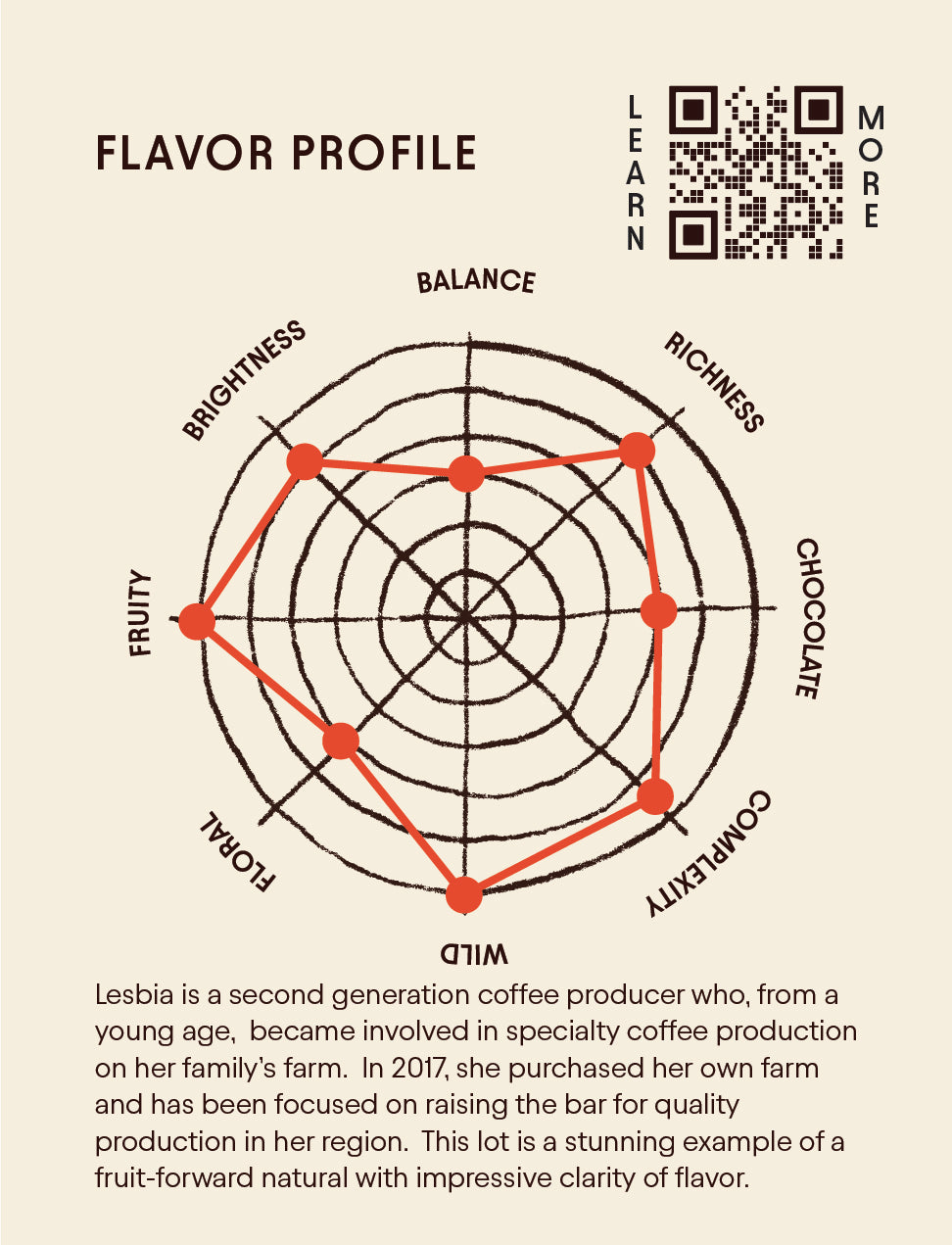
Juicy fruit punch and ripe plum lead a wildly complex cup, with layered, wine-like acidity and a rich, syrupy body. Nutella-like chocolate sweetness rounds out the fruit, leading to a remarkably clean finish for such a wild cup.


Regular price $30.00 CAD
Regular price $0.00 CAD Sale price $30.00 CAD
Sale Sold out
Shipping calculated at checkout.
Size
Grind Size
Quantity

View full details
A black and white photograph of the flag of Honduras waving on a flagpole, with palm tree silhouettes in the foreground and a cloudy sky behind.

Technical Information

Producer: Lesbia Sabillion

Region: Los Laureles, Santa Barbara, Honduras

Harvest: Spring 2026

Varietal(s): Parainema

Process: Natural Process

Altitude: 1500 masl

Sourcing Partner: Beneficio y Exportadora San Vicente 

Agtron Gourmet Color: 104 (light)

Roasters Cupping Score: 87.75

close up black and white photo of coffee plants.

Coffee Story

Lesbia began working in coffee as a child on her family’s farm, gaining early experience in both cultivation and post-harvest processing under the guidance of her father. This foundational knowledge formed the basis of her technical skills in coffee production.

In 2017, Lesbia acquired 2.1 hectares of land near Los Laureles, where she established Finca Genesis. She and her husband, Belarmino, currently manage two farms in the Santa Bárbara region—one owned by Belarmino prior to their partnership, and Finca Genesis.

A large coffee drying room, photographed from a distance on a cloudy day. A paved courtyard leads up the center toward the open front doors, with a small mound of material in the foreground.

Belarmino is responsible for farm management, including cultivation practices, pruning, fertilization schedules, and harvest logistics. Lesbia oversees all aspects of post-harvest processing, including cherry selection, fermentation protocols, washing, and drying. Her focus is on producing clean, high-quality lots with precise control over fermentation times, water usage, and drying conditions to meet specialty market standards.

Their coffees reflect a combination of traditional knowledge and attention to processing detail, resulting in consistent cup profiles suitable for both single-origin offerings and competition-quality lots.

After offering Lesbia’s coffee for the first time last year, we had the chance to visit her and Belarmino this past spring. Stepping into their perfectly designed parabolic drying house, pictured here, the first thing that hits you is the aroma—intensely sweet and jammy, with coffee cherries drying throughout the space.

Seeing their work firsthand gave us an even greater appreciation for the care behind their naturals. Their attention to processing shows clearly in the coffees: expressive, fruit-driven, and beautifully produced. We’re excited to continue working with Lesbia and Belarmino, to deepen this relationship over the years, and to share more of their coffees along the way.

Collapsible content

Varietal

Parainema is a hybrid varietal developed through the selective breeding program at the Honduran Institute of Coffee. The varietal is known for its good cup quality and is suited for production at low to medium altitudes that are common throughout Hondura's coffee production areas. The varietal is highly resistant to leaf rust, the most common coffee disease in Central America, as well as to a number of common coffee pests in the region. As a dwarf varietal, Parainema is less challenging to harvest when compared to full size varieties and it is known for relatively high production per hactare.

Processing

Coffee cherries are carefully hand-picked at their optimal stage of ripeness. After harvesting, the cherries are spread evenly on raised beds in a parabolic drying house where they are dried for 2-3 weeks, depending on weather. During this drying period, the cherries are regularly rotated by hand — typically every 20 minutes — to promote uniform drying.

Terroir

Montaña Santa Bárbara rises dramatically from the western edge of Lake Yojoa, where coffee farms climb the steep slopes of the mountain. Elevation changes quickly here, with coffee growing below a mountain that reaches more than 2,700 meters. At the highest elevations, farms give way to the protected forests of Montaña de Santa Bárbara National Park, where dense cloud forest covers the upper slopes. The mountain itself is an unusual limestone formation rather than a volcano, with its porous karst geology also playing an important role in the region’s watersheds. 

Lake Yojoa is equally important in shaping the growing environment. Moisture and fog coming off the lake move into the surrounding mountains, contributing to the cool, humid conditions found on Santa Bárbara’s coffee-growing slopes. Combined with elevation and frequent cloud cover, these conditions slow the maturation of coffee cherries and can create a long, staggered harvest. 

The result is one of Honduras’s most distinctive coffee landscapes: steep farms situated between a large tropical lake below and protected cloud forest above. Santa Bárbara has become known for coffees with pronounced sweetness, vibrant acidity and complex fruit character—a profile closely tied to the unusual interaction of elevation, lake, forest and climate found here.