Skip to product information
1 of 3

Guatemala - El Platanillo Heirloom

Guatemala - El Platanillo Heirloom

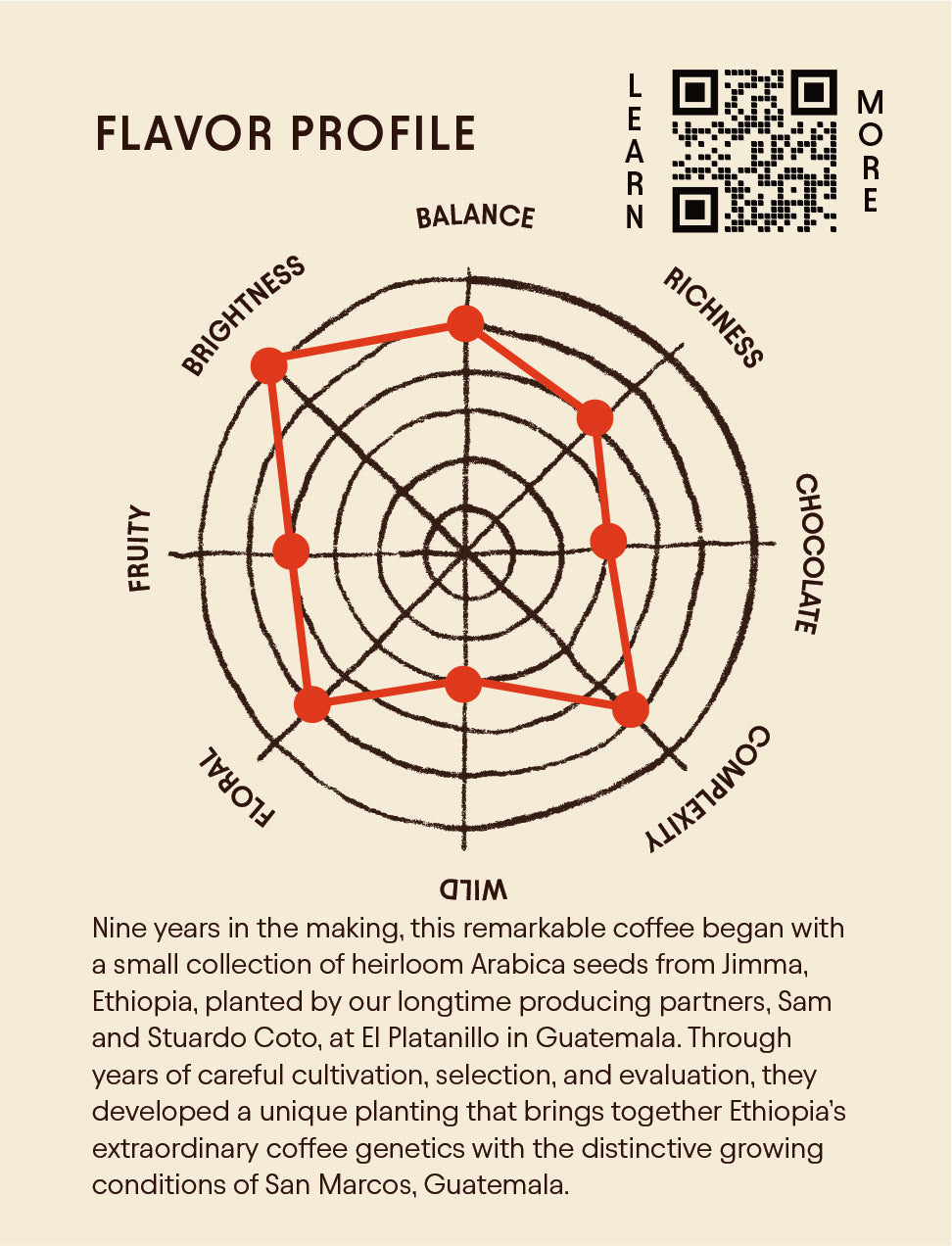
Vibrant and exceptionally clear, with notes of jasmine and lime zest throughout the cup, complemented by the rich sweetness of apple compote and streusel.


Regular price $10.00 USD
Regular price $0.00 USD Sale price $10.00 USD
Sale Sold out
Shipping calculated at checkout.
Size
Grind Size
Quantity

View full details

Technical Information

Producer: Stuardo and Samuel Coto

Region: San Rafael Pie de la Cuesta, San Marcos, Guatemala

Harvest: Winter 2025/Spring 2026

Varietal(s): Ethiopia Heirloom

Process: Carbonic Maceration Washed

Altitude: 1,450 masl

Roasters Cupping Score: 87

Agtron Gourmet Color: 101 (light)

Sourcing Partner: Panorama Coffee

Coffee Story

Nine years ago, a small collection of coffee seeds originating from Jimma, Ethiopia, became the starting point of a unique project on the farm of our friends and producing partners, Stuardo and Sam (pictured) Coto, in San Marcos, Guatemala.

Ethiopia is the birthplace of Arabica coffee and home to an extraordinary diversity of coffee genetics. Jimma, in the southwestern part of the country, is an important coffee-growing region known for its genetic diversity and long history of coffee cultivation. Interested in exploring how these genetics might express themselves in a different growing environment, Sam and Stuardo began a multiyear process of cultivation, observation, and selection.

While Jimma is characterized by humid, forested highlands, the Cotos' farm sits on the Pacific-facing slopes of Guatemala's Sierra Madre, where volcanic terrain, exceptionally abundant rainfall, and a prolonged wet season provide a distinctly different environment for the expression of Ethiopian coffee genetics. This contrast between the two growing regions adds another dimension to the project, offering an opportunity to explore how plants originating in Jimma adapt to the environmental conditions of San Marcos.

It would be three years before the first plants produced coffee. At that point, the plants were separated according to their physical characteristics, including height and the color of their emerging leaves (gold tip or green tip). Seeds from these different groups were planted in separate lots, beginning another three-year growing cycle.

Three years later (six years after the initial planting), the second generation reached production. Each lot was harvested, processed, and evaluated for cup quality. Among the different selections, one stood out: taller plants with green growing tips and a physical resemblance to Bourbon and Typica. The coffee from these plants was exceptionally sweet, with a pronounced floral character. With the quality confirmed through cupping, this selection was established as a dedicated planting on the farm.

Today, nine years after those first seeds were planted, we're finally getting to taste the results of the decisions Sam and Stuardo made along the way. From the initial planting and selection of individual plants to the establishment of a dedicated lot, each step has contributed to the coffee we're enjoying today. It's a rare opportunity to experience the results of years of thoughtful agricultural work in a single cup.

What makes this project particularly interesting to us is the relationship between genetics, environment, and the work of the producer. Through successive generations of selection, Sam and Stuardo identified plants that exhibited both excellent cup quality and the vigor needed to perform well on their farm. While the coffee's genetic heritage traces to Ethiopia, its character also reflects the growing conditions in San Marcos and the agricultural decisions made throughout the project.  

Projects like this are a reminder of what drew us to specialty coffee in the first place. Behind every exceptional coffee is a combination of genetics, place, and the knowledge and dedication of the people responsible for cultivating it. We're excited to finally share the results of Sam and Stuardo's work.

Collapsible content

Varietal

Ethiopia is home to the world's greatest genetic diversity of Arabica coffee, with thousands of distinct varieties and landraces, many of which remain genetically unclassified. The term Ethiopia Heirloom broadly describes these traditional coffee populations rather than a single, genetically uniform cultivar. These diverse populations are known for their exceptional sensory potential, often exhibiting expressive floral aromatics, vibrant acidity, and complex fruit character.

Originating from seed collected in Jimma, Ethiopia, this particular selection began as a genetically diverse population exhibiting a range of growth habits and physical characteristics. Through successive generations of cultivation, observation, and cupping, producers Sam and Stuardo Coto selected plants exhibiting a tall growth habit, green-tipped new leaves, and desirable sensory qualities. By propagating these selected plants, they have worked toward establishing a more uniform and distinct expression of Ethiopian coffee genetics, now cultivated in Guatemala's San Marcos region.

Processing

Carbonic maceration is a controlled fermentation technique adapted from winemaking that uses a carbon dioxide-rich, oxygen-limited environment to influence microbial activity and flavor development. 

Whole, ripe coffee cherries are placed in sealed fermentation tanks, where carbon dioxide is introduced to displace oxygen. Within this environment, fermentation occurs through a combination of microbial activity and metabolic processes within the intact coffee cherries, encouraging the development of complex aromatic compounds and distinctive fruit characteristics.  This coffee was CM fermented for 96-hours.

Following carbonic maceration, the cherries are depulped and the remaining mucilage is removed through fermentation and washing before the coffee is dried. This combination of techniques seeks to balance the enhanced aromatic complexity and fruit expression associated with carbonic maceration with the clarity, structure, and clean finish typically associated with washed processing.

Although this is a high-intervention processing method, the Coto's and their team have a masterful hand at processing.  The process is not felt in heavy fermentation flavors in the cup but rather it enhances the coffee's innate sensory characteristics.  The result is a clean and clear, vibrant expression of varietal and place.

Terroir

Situated along the Pacific-facing slopes of Guatemala's Sierra Madre mountain range, San Rafael Pie de la Cuesta is shaped by a warm, humid climate, abundant seasonal rainfall, and the volcanic geology of western Guatemala. Moisture-laden air moving inland from the Pacific interacts with the mountainous terrain, creating a dynamic environment of cloud cover, mist, and shifting temperatures. The region's well-drained, mineral-rich soils and pronounced wet and dry seasons provide distinctive growing conditions for Arabica coffee.

The steep, irregular landscape creates substantial variation in growing conditions over relatively short distances, with differences in exposure, temperature, and moisture contributing to a patchwork of microclimates. San Marcos is among Guatemala's wettest coffee-growing regions, and its combination of volcanic terrain, Pacific influence, and abundant rainfall distinguishes it from the country's drier coffee-producing areas.